An Elm Bool is a single bit inside a function, a 64-bit word when it is passed to an unknown closure, and the same word again when it is stored in a list. Eco keeps four separate models of every value (inside a function, across a call, in the heap, and its Elm meaning) and converts at a small number of fixed points. Most of the design follows from making those conversions cheap, and from making a heap pointer nothing more than the object's address.
Background
- Boxed and unboxed: a boxed value is reached through a pointer; an unboxed one is stored directly as a machine number.
- SSA: the form of the compiler's intermediate code, where each value is defined once and has one machine type.
- The ABI is the agreement on how values are passed between functions.
Four models of one value
Take True. In Elm it is just a constructor of Bool. Each of the four models gives it a different form:
| Model | Where it applies | True is | 5 : Int is |
|---|---|---|---|
| Logical | Elm meaning: equality, ordering, pattern matching | True | 5 |
| SSA | inside one function body | i1 value 1 | i64 5 |
| ABI | arguments, results, captured values | the word 0x5 | i64 5 |
| Heap | a field of a heap object | the word 0x5 | raw i64 5, marked as an Int slot |
The models are kept apart because each has a different job. Inside a function, LLVM wants the narrowest machine type, so a Bool is a one-bit integer it can branch on. Across a call or in a heap field, every value except a number has to fit in one uniform 8-byte slot, so Bool becomes a word. Each model's type is computed by one function of the value's specialized type, so every site that builds or reads a value agrees on its form.
Only three types are ever stored raw outside a function: Int (a 64-bit integer), Float (a 64-bit float) and Char (one 16-bit UTF-16 code unit). Everything else, Bool included, is a word. A type variable that Monomorphization left unconstrained is also a word, so an Int passing through an a parameter is boxed into a 16-byte heap object. That way the code that sees the value as a and the code that sees it as Int agree on a single word.
The value word
Every boxed value is one 64-bit word with this layout:
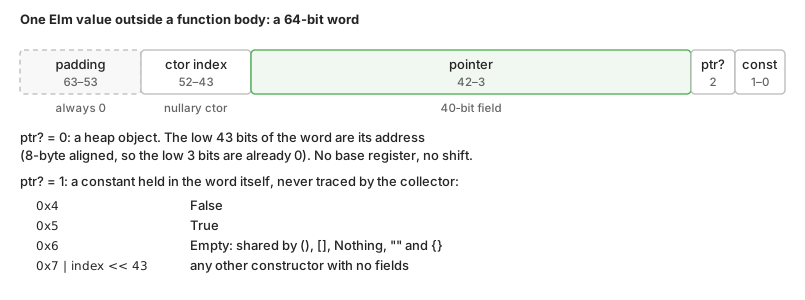
The runtime declares it as a C bit-field, least significant bits first (from the runtime's heap definitions):
typedef enum { Const_False = 0, Const_True = 1, Const_Empty = 2, Const_NullCons = 3,} Constant;typedef struct { u64 constant : 2; // bits 0-1 u64 ptr_ind : 1; // bit 2: 0 = heap pointer, 1 = constant u64 ptr : POINTER_BITS; // bits 3-42 (40 bits) u64 null_cons_idx : 10; // bits 43-52 u64 padding : 11; // bits 53-63, always 0} HPointer;The design rests on the low three bits. Every heap object is 8-byte aligned, so the low three bits of its address are always zero, and Eco puts the constant code and the pointer indicator exactly there. For a heap pointer those bits are zero, and the 40-bit ptr field starting at bit 3 holds the rest of the address. The low 43 bits of the word therefore are the raw address: dereferencing needs no base register, no add and no shift. The heap is reserved below 2^43 bytes (8 TB) so that every address fits.
A word with bit 2 set is a constant embedded in the word. It is never allocated and never traced by the collector. The fixed words are:
| Value | Word | Why |
|---|---|---|
False | 0x4 | indicator set, code 0 |
True | 0x5 | indicator set, code 1 |
(), [], Nothing, "", {} | 0x6 | indicator set, code 2: one shared Empty |
| a nullary constructor at declaration index i | (i << 43) | 0x7 | indicator set, code 3, index in bits 43-52 |
| null | 0x0 | used only internally |
For type Order = LT | EQ | GT, LT is 0x7, EQ is 0x0000080000000007 and GT is 0x0000100000000007. Each saves a 16-byte heap object every time one is produced.
Bit 0 of False and True is the Bool's own one-bit value. Converting between the SSA form and the word is cheap: boxing a Bool is a select between 0x5 and 0x4, and unboxing is a compare with 0x5. Neither allocates.
This choice has a cost. False has constant code 0, the same as a heap pointer, so code can never test "is this a pointer?" by looking at the code bits. Bit 2 is the only legal test. Testing for null, or whether the word falls in the heap's address range, is ruled out too, because the range depends on where the heap happens to be reserved.
One Empty for five types
A single word, 0x6, stands for (), [], Nothing, "" and {}. Merging them is safe because Elm is typed: the type checker guarantees that each is only produced and matched where its own type is expected, so the word never has to say which empty it is. The cost is that a case cannot learn the constructor from the word alone, so when it meets Empty it reads a reserved tag instead.
The merge also means an embedded value must exist only in its embedded form. Equality concludes "not equal" as soon as one side is an embedded constant and the words differ. A heap object holding LT, or a heap string of length zero, would compare unequal to the real LT or "". Every producer returns the constant, and no zero-length heap string is ever built.
A real example
Here is the list [ 1, 2, 3 ] and the value Rect 2 3 as Eco's compiler emits them for the shapes program used in A tour through the compiler (trimmed: type annotations on operands removed):
%30 = "eco.constant"() {kind = 2 : i32} : () -> !eco.value%31 = "arith.constant"() {value = 3 : i64} : () -> i64%32 = "eco.construct.list"(%31, %30) {head_kind = 1, head_unboxed = true} : (i64, !eco.value) -> !eco.value%33 = "arith.constant"() {value = 2 : i64} : () -> i64%34 = "eco.construct.list"(%33, %32) {head_kind = 1, head_unboxed = true} : (i64, !eco.value) -> !eco.value%35 = "arith.constant"() {value = 1 : i64} : () -> i64%25 = "eco.construct.list"(%35, %34) {head_kind = 1, head_unboxed = true} : (i64, !eco.value) -> !eco.value%12 = "arith.constant"() {value = 2.0 : f64} : () -> f64%13 = "arith.constant"() {value = 3.0 : f64} : () -> f64%14 = "eco.construct.custom"(%12, %13) {constructor = "Rect", size = 2, slot_kinds = array<i8: 2, 2>, tag = 1} : (f64, f64) -> !eco.value[] is eco.constant with kind 2, Empty, which becomes the word 0x6. Each cons cell stores its Int head raw (head_kind = 1). Rect is constructor 1 of Shape, with two raw Float fields (kind 2 each).
Slot kinds: how the collector tells numbers from pointers
Every slot of a heap object carries a two-bit kind: 00 boxed word, 01 raw Int, 10 raw Float, 11 raw Char. The collector reads only these kinds, so it can tell a raw integer from a pointer without knowing any Elm types. OCaml solves the same problem the other way, by stealing the low bit of every integer, which leaves it 63 bits. We prefer to keep Int at a full 64 bits and put the information in the object instead.
Four codes is exactly boxed plus three primitives, which is why only Int, Float and Char are ever raw. A raw Bool would spend a code for nothing, since boxing a Bool costs nothing. Small objects (cons cells, tuples) keep their kinds in the 8-byte object header. Larger ones (records, custom types, closures) keep them in a packed word after the header, with extra kind words at the end of the object when there are many fields, so a field always stays at its own position however many fields there are.
Layouts are pure functions of the type, recomputed at every site that builds or reads an object. Record fields go raw first, then boxed, each group sorted by name, so { x, y } and { y, x } share a layout. Custom-type fields keep declaration order. No layout table is stored anywhere.
Where a value changes form
Conversions happen only at fixed seams, and each has one operation:
| Seam | Conversion | Cost |
|---|---|---|
| Into a call, capture or partial application | eco.box (a Bool, or a number whose target is an a) | Bool: a select. Number: allocates a 16-byte box |
| Out of a call | eco.unbox | Bool: a compare. Number: one load |
| Building a heap object | raw numbers stored as they are; a Bool boxed first | none |
| Reading a field | typed by the slot's kind | one load |
| Stack aggregate to heap and back | eco.to_heap, eco.from_heap | eco.to_heap allocates |
Code generation decides whether to convert by comparing the value's actual SSA type with the type the target expects, never by reasoning from the declared Elm type. A declared type that disagrees with how a value is stored is exactly the bug the four models exist to prevent.
Below this there is a fifth, mechanical form. Inside LLVM, a boxed value has the type ptr addrspace(1), which is how LLVM knows which values are heap pointers the collector may move. It becomes a plain integer only at the instant it is written to or read from memory.
Designs we didn't use. The word could store a 40-bit offset from a heap base rather than the address itself. We rejected it because every dereference pays an add and a shift, and its True and False share no bit with the one-bit Bool, so boxing and unboxing a Bool would no longer be a single select or compare.
Further reading
- Closures and calls — how slot kinds drive argument conversion in closures.
- The garbage collector — the object header, and why the heap sits below 2^43.
- Runtime data structures — the forms of strings and lists behind a single word.
- The eco dialect — the types
!eco.value,i64,f64and the construction operations. - The full design document: Value representation theory
- Source:
runtime/src/allocator