After monomorphization every function has concrete types, but nothing yet says how each call should be made: as a direct jump to a known function, as a fast call into a known closure, or through the runtime's generic apply. Global optimization makes all of those decisions in one place and writes each one onto its call. Its rule is to prove or decline. A missed proof costs only speed, because the generic path is always correct. A wrong proof is a silent miscompile.
Background
- A closure is a function value together with the values it captured. A partial application is a closure that holds some of its arguments.
- Staging and arity: a stage is the group of parameters a closure takes in one application.
\x y -> x + yhas one stage of two; a function that returns a lambda has two stages. - A lambda set is the set of functions that can reach a given call site, as worked out by lambda-set specialization.
A small example
This program, from the examples we compile for these docs, has the shapes global optimisation exists for: a function that returns a lambda, a definition that is just another name, and a partial application used as a function.
adder a = \b -> a + b

scale k =
    let k2 = k * k in
    \x y -> k2 * x + y

twice f x = f (f x)

dup = twice

inc = adder 1

main =
    let
        s = scale 3
        r2 = s 4 5
        r3 = dup inc 10
        ...
Here is what reaches MLIR, compiled with the inliner turned down (ECO_INLINE_THRESHOLD=0) so that each function stays visible (trimmed: operand types and most function attributes removed):
"func.func"() ({ ^bb0(%k: i64, %x: i64, %y: i64): %3 = "eco.int.mul"(%k, %k) : (i64, i64) -> i64 %5 = "eco.int.mul"(%3, %x) : (i64, i64) -> i64 %6 = "eco.int.add"(%5, %y) : (i64, i64) -> i64 "eco.return"(%6) : (i64) -> () }) {function_type = (i64, i64, i64) -> (i64), sym_name = "Stage_scale_$_1"} "func.func"() ({ ^bb0(%_eta3: i64): %1 = "arith.constant"() {value = 1 : i64} : () -> i64 %2 = "eco.call"(%1, %_eta3) <{callee = @Stage_adder_$_5}> : (i64, i64) -> i64 "eco.return"(%2) : (i64) -> () }) {function_type = (i64) -> (i64), sym_name = "Stage_inc_$_3"} "func.func"() ({ ^bb0(%f: !eco.value, %x: i64): %2 = "eco.call"(%x) <{callee = @Stage_inc_$_3}> : (i64) -> i64 %3 = "eco.call"(%2) <{callee = @Stage_inc_$_3}> : (i64) -> i64 "eco.return"(%3) : (i64) -> () }) {function_type = (!eco.value, i64) -> (i64), sym_name = "Stage_twice_$_4"}Four things happened.
scaleis one function of three integers. Local optimization merged the two function boundaries, and global optimisation gave the closure the type of its real parameters. Inmain,s 4 5became a single direct call,Stage_scale_$_1(3, 4, 5). The merge has a cost:k * know runs on every call ofsrather than once whensis built. Here that is one multiplication.incwas written with no parameters. Eta-expansion gave it the one its type declares (%_eta3), so it is an ordinary one-argument function that callsadderdirectly.duphas gone. It was only another name fortwice, and alias forwarding pointed every use of it attwiceitself.maincallsStage_twice_$_4directly.- Inside
twice, the two calls offbecame direct calls ofStage_inc_$_3. The lambda set forfheld onlyinc, so global optimisation devirtualised the calls. The parameter%fis still passed but is no longer read.
Prove the call, or leave it generic
Elm functions are curried. A function of type Int -> Int -> Int can be applied to both arguments at once or to one at a time. Monomorphization writes every function type in curried form and says nothing about stages; global optimisation chooses them.
The fallback is always available. A closure's header says how many arguments it still needs and how to call it, so the runtime can apply any closure to any number of arguments (Closures and calls shows how). The fast paths are another matter. They load captured values from fixed positions and jump to fixed code with no check at run time. Every pass in this phase therefore declines by default and acts only on a narrow license it can check.
Staging is decided here and nowhere else, and in our view this is the only safe place to decide it. When the specializer and the code generator each work out call shapes for themselves, they can disagree, and the code generator ends up guessing arities from context. With one deciding phase, monomorphization can ignore staging altogether, and MLIR generation only reads the record it is given.
The steps, in order
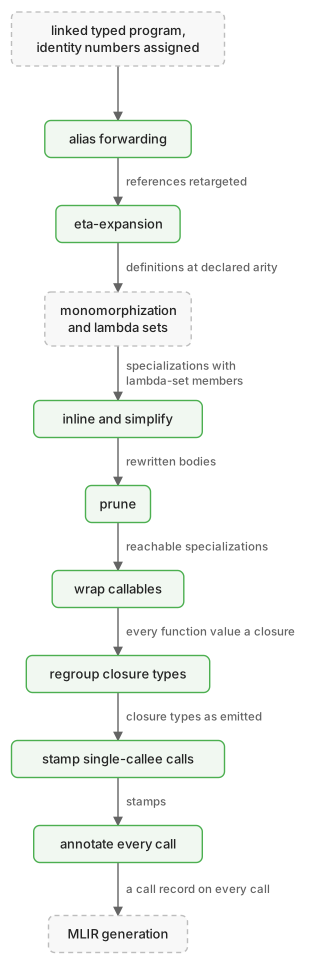
Two steps run before monomorphization, and their job is to put a visible callee at more call sites, because a lambda set can only shrink to one member where a call names a concrete lambda or a top-level function.
- Alias forwarding replaces a reference to a definition such as
dup = twice, orBasics.add, which only names a C++ kernel, with a reference to its target. Nothing is copied, so the lambda-set analysis then tracks the target itself rather than a wrapper. - Eta-expansion gives a definition the parameters its type declares but its code does not write, as with
inc. It moves any work before the added parameters from once per partial application to once per call, so a cheapness test limits it to bodies whose early work is building a value, a small call, or a kernel that does not allocate.
The rest run on the specialized program.
- Inline and simplify. Small non-recursive specializations are inlined on their concrete types, repeatedly, until the bodies stop changing. Kernel calls are priced from a hand-audited table of what each kernel does. One rewrite copies a tail-recursive higher-order function, such as a fold, into a caller that passes it a lambda literal, so that the loop calls the lambda directly.
- Prune drops the specializations that inlining left unreachable. It is a separate step because whether a function is dead is a property of the whole program, and a callee's body must survive until the inliner has finished.
- Wrap callables. Every function-valued top-level definition that is not already a closure becomes one, so the next step has a parameter list to work from.
- Regroup closure types. Every closure gets the type
[its parameters] -> [the rest] -> result. A closure's own parameter count is the one fact about staging that holds everywhere, so it is the only fact this step writes. - Stamp single-callee calls. Where a call's lambda set has one member, this step marks the call for a fast closure call, or turns it into a direct call of the one matching specialization, as in
twice. - Annotate every call with a record of its call kind and the grouping of its arguments, which code generation reads.
Every lambda carries an identity number that the lambda-set analysis keys on. A pass that copies code, as the inliner does, must give the copy fresh numbers: two different bodies under one number would be a silent miscompile. All passes take their numbers from one minting module, and a check rejects numbers that are missing or duplicated.
The four call kinds
Each call leaves global optimisation with one of four kinds. They appear in the MLIR as the _call_kind attribute on a closure application:
| Call kind | Meaning | Where it shows up |
|---|---|---|
direct_known_segmentation | the callee's stages are known, so arguments are applied knowing how many each stage takes | scale 2 1 above: two arguments given to a known three-argument function |
singleton_fast | the call's lambda set has one member, so code generation calls that closure's code directly | the step function inside List.map (scale 2 1) in the same program |
segmentation_unknown | the callee is known only from its type; the runtime splits the arguments by the closure header | g acc in List.foldl (\g acc -> g acc) 1 [ \x -> x + 1, \x -> x * 2, negate ], where three different functions arrive |
generic_apply | nothing is known; the runtime does all of it | f acc in a repeatApply f n acc loop, but only with lambda-set specialization turned off; with it on, the same call is singleton_fast |
Calls to kernels and to top-level functions with all their arguments are plain eco.calls and need no kind at all. Two lines from the example show the first two kinds (trimmed):
%4 = "eco.papExtend"(%6, %7, %8) {_call_kind = "direct_known_segmentation", remaining_arity = 3, ...} : (!eco.value, i64, i64) -> !eco.value%12 = "eco.papExtend"(%fn, %7, %acc) {_call_kind = "singleton_fast", _fast_evaluator = @Stage_lambda_12$cap, remaining_arity = 2, ...} : (!eco.value, i64, !eco.value) -> !eco.valueThe order of the tests is the policy. A known segmentation needs every test to pass: the callee must come from something the phase can see (a top-level function, a closure bound by let or captured, or a tail-recursive definition); it must not be a function-typed parameter of an enclosing loop; and it must not trace back to a partial application whose return type was polymorphic. An arity read only from the type never claims a known segmentation. A case or if that produces closures yields known stages only when every branch agrees; Eco does not re-stage branches to make them agree, and leaves such joins to the runtime.
Two rules every pass shares
Every pass that needs to know what a C++ kernel does reads the same table: whether it allocates, whether it can fail, which arguments are functions, whether two calls can be merged. The table is a whitelist. A kernel with no row licenses nothing.
Debug output is observable on the native path, because optimised native builds keep Debug calls. Therefore no pass may delete, merge or reorder an expression that can reach a Debug kernel, directly or through the functions it calls. A whole-program analysis works out which specializations can.
Designs we didn't use. A staging solver could group closures into classes, vote on one staging per class and wrap the closures that disagree. We built one, and on every program we measured it inserted no wrappers and the output without it was byte for byte the same, so Eco does without it.
Further reading
- Lambda-set specialization — how the sets that license direct and fast calls are computed.
- Monomorphization — the step that hands this phase a fully specialized program.
- MLIR generation — the consumer of the call records written here.
- Closures and calls — the generic apply that every declined proof falls back on.
- Optimisations — every optimisation in one place.
- The full design document: Global optimization theory
- Source:
compiler/src/Compiler/GlobalOpt