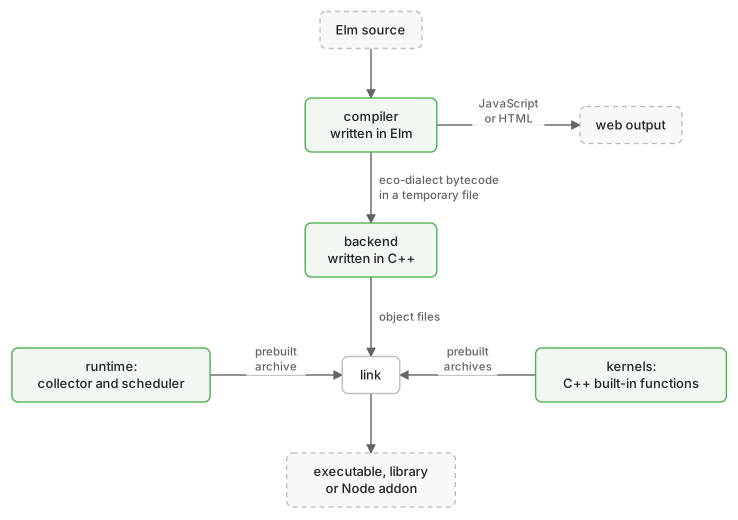
This page follows one 49-line Elm program through every stage of Eco, from source text to a native executable, and shows what the compiler actually produces at each step. In our view, watching one program go through a compiler explains it faster than any description of the stages. By the end, a case over three shapes has become a three-way branch on a tag, an Int list has its numbers stored directly in the list cells, and a function passed as an argument is called directly.
Background
- MLIR: a framework for writing compiler intermediate languages, each called a dialect.
- Monomorphization: making one copy of a generic function for each type it is used at.
- Lambda set: the set of functions that can reach a particular call through a function value.
- Lowering: rewriting operations of a high-level dialect into simpler ones, ending in LLVM's.
Following along
Every listing of compiler output below comes from Eco 0.2.0. To reproduce it, put the program in src/Main.elm of an Elm project and run:
eco make src/Main.elm --text-mlir --output=main.mlirThe .mlir ending asks for the compiler's output just before the backend, and --text-mlir makes it readable text instead of bytecode. Setting ECO_INLINE_THRESHOLD=0 in the environment stops the inliner absorbing small functions, which helps when you want to see every function survive. The listings omit the _operand_types attribute that Eco puts on every operation, and are marked "trimmed" where they do.
1. The program
The program has a custom type and a function that matches on it:
type Shape
    = Circle Float
    | Rect Float Float
    | Square Float


area : Shape -> Float
area shape =
    case shape of
        Circle r ->
            3.14 * r * r

        Rect w h ->
            w * h

        Square s ->
            s * s
It also has a tail-recursive loop, a higher-order function, a function over number, and a main that uses all of them:
sumTo : Int -> Int -> Int
sumTo acc n =
    if n <= 0 then
        acc

    else
        sumTo (acc + n) (n - 1)


twice : (a -> a) -> a -> a
twice f x =
    f (f x)


add : number -> number -> number
add a b =
    a + b


main =
    text
        (String.fromInt (sumTo 0 (twice (add 1) 10))
            ++ String.fromFloat (area (Rect 2 3))
            ++ String.join "," (List.map String.fromInt (List.map (\x -> x * 2) [ 1, 2, 3 ]))
        )
Three things in it are hard for a native compiler. twice and add do not say what types they work on. area receives a value whose shape is only known at run time. twice calls a function it was handed, which in general could be any function at all.
2. The front end: keeping the types
Eco's front end is Elm's own, by way of Guida, a port of the Elm compiler to Elm. It parses the module, resolves every name to the module that defines it, and runs Elm's type checker, so a type error in this program would read exactly as it does under elm make.
Stock Elm's type checker answers one question, whether the program is well typed, and throws away its working. Eco keeps the answers, because the stages that follow need the type of every expression, and it keeps them by number. While resolving names, the front end gives every expression and pattern a number, and after solving it fills a table indexed by that number:
type alias ExprInfo =
    { id : Int
    , node : Expr_
    }

type alias ExprTypes =
    Array (Maybe (Can.Type Name))
The expression w * h inside area has a number, and its entry in the table says Float. The expression a + b inside add has the type number. That is as far as the front end can go, because add is generic, and nothing can be decided about number until the whole program has been seen. Literals such as 1 keep the type number for the same reason.
More in The front end.
3. Local optimization: the case becomes a decision tree
Next, each module is optimised on its own, with rewrites that need neither the rest of the program nor concrete types. The most visible is pattern matching. A case becomes a decision tree in which each part of the value is tested at most once. The shape of that tree, from the compiler's typed optimised form, is:
type Decider a
    = Leaf a
    | Chain (List ( DT.Path, DT.Test )) (Decider a) (Decider a)
    | FanOut DT.Path (List ( DT.Test, Decider a )) (Decider a)
A Leaf is a branch body. A Chain runs a list of tests and goes one way or the other. A FanOut looks at one place in the value (the path) and picks among several tests. For area, the tree is a single FanOut at the root, shape, with the tests "is it a Circle?" and "is it a Rect?", each leading to a Leaf. Square becomes the fallback rather than a third test. The match is known to be complete, so a value that is neither of the others must be a Square, and nothing needs to check.
The same stage turns sumTo, which calls itself in tail position, into a tail-call definition that will become a loop. It also rewrites &&, || and the pipe operators into conditionals and plain calls. Every rewritten node keeps the type the front end recorded, because the next stage needs it.
More in Local optimization.
4. Monomorphization: one copy per type
Native code has to know how big a value is and which machine instructions operate on it. An Int is 64 bits in a register, a Float is a 64-bit floating-point register, and a String is a pointer to the heap. A generic function such as add cannot be compiled once for all of them, so the compiler links all the modules, starts from main, and makes one copy of each function for each combination of types it is used at. Each copy is called a specialization.
In this program add is only ever used on Int, so there is one copy, and its number has become Int. Each specialization's name is its module, its name, and a number that keeps names unique. These are the program's own specializations, with their machine-level signatures:
Main_main_$_0    () -> !eco.value
Main_add_$_1     (i64, i64) -> i64
Main_sumTo_$_3   (i64, i64) -> i64
Main_Rect_$_4    (f64, f64) -> !eco.value
Main_area_$_5    (!eco.value) -> f64
Main_lambda_0    (i64) -> i64
i64 and f64 are unboxed machine integers and floats, and !eco.value is a pointer to a heap object. Main_Rect_$_4 is the Rect constructor used as a function. Main_lambda_0 is \x -> x * 2, known to take and return Int. From elm/core come String_fromInt_$_6, String_join_$_9, and two copies of the helper behind List.map, List_foldrHelper_$_14 and List_foldrHelper_$_20. One builds a list of strings and the other a list of integers. They are the same Elm code compiled twice, because the element types differ and so do the callbacks.
twice is missing from the list. The inliner gives a function that calls one of its own parameters a larger budget, because inlining it lets the function argument be called directly. twice was therefore copied into main and its specialization removed. That happens even with ECO_INLINE_THRESHOLD=0. The gaps in the numbering are specializations like this one, created and later inlined away.
More in Monomorphization.
5. Global optimization: deciding how every call is made
With the whole program specialized, Eco decides, once for each call, how it will be made. Calling a known function with all its arguments is an ordinary call. A call through a function value is harder: the callee might need more arguments than it is given, or fewer, and in general the runtime has to look at the closure to find out. Global optimization records the answer on each call as a call kind, so code generation never has to work it out again.
After inlining, twice (add 1) 10 has become f (f 10) with f = add 1. Here is what the compiler made of it (trimmed):
%4 = "eco.papCreate"() {arity = 2, function = @Main_add_$_1, num_captured = 0} : () -> !eco.value%5 = "arith.constant"() {value = 1 : i64} : () -> i64%2 = "eco.papExtend"(%4, %5) {_call_kind = "direct_known_segmentation", remaining_arity = 2} : (!eco.value, i64) -> !eco.value%3 = "arith.constant"() {value = 10 : i64} : () -> i64%8 = "eco.papExtend"(%2, %3) {_call_kind = "singleton_fast", _fast_evaluator = @Main_add_$_1, remaining_arity = 1} : (!eco.value, i64) -> i64%9 = "eco.papExtend"(%2, %8) {_call_kind = "singleton_fast", _fast_evaluator = @Main_add_$_1, remaining_arity = 1} : (!eco.value, i64) -> i64%10 = "eco.call"(%1, %9) <{callee = @Main_sumTo_$_3}> : (i64, i64) -> i64papCreate and papExtend build and apply partial applications. The first papExtend gives add one of its two arguments, and because the compiler knows add's arity, the result is recorded as a partial application still waiting for one argument. The next two are the calls f 10 and f (f 10). Lambda-set analysis has proved that the only function that can arrive at them is add 1, so they are marked singleton_fast, with Main_add_$_1 as the function to call. They pass i64 in and get i64 back, without going through the runtime's generic apply routine, which would have to inspect the closure. The call to sumTo is a plain eco.call.
More in Global optimization and Lambda-set specialization.
6. MLIR generation: writing down the decisions
By this stage everything is decided, and code generation only writes the decisions down in Eco's own MLIR dialect, the contract between the Elm half of the compiler and the C++ half. The smallest function shows the format (trimmed):
^bb0(%a: i64, %b: i64): %2 = "eco.int.add"(%a, %b) : (i64, i64) -> i64 "eco.return"(%2) : (i64) -> ()}) {function_type = (i64, i64) -> (i64), sym_name = "Main_add_$_1"}Every value is in SSA form: assigned once, with its type written out. add is two 64-bit integers in, one out, with no heap anywhere. Here is area (trimmed):
^bb0(%shape: !eco.value): %14 = "eco.case"(%shape) ({ %2 = "eco.project.custom"(%shape) {field_index = 0} : (!eco.value) -> f64 %3 = "arith.constant"() {value = 3.14 : f64} : () -> f64 %4 = "eco.float.mul"(%3, %2) : (f64, f64) -> f64 %5 = "eco.float.mul"(%4, %2) : (f64, f64) -> f64 "eco.yield"(%5) : (f64) -> () }, { %7 = "eco.project.custom"(%shape) {field_index = 0} : (!eco.value) -> f64 %9 = "eco.project.custom"(%shape) {field_index = 1} : (!eco.value) -> f64 %10 = "eco.float.mul"(%7, %9) : (f64, f64) -> f64 "eco.yield"(%10) : (f64) -> () }, { %12 = "eco.project.custom"(%shape) {field_index = 0} : (!eco.value) -> f64 %13 = "eco.float.mul"(%12, %12) : (f64, f64) -> f64 "eco.yield"(%13) : (f64) -> () }) {case_kind = "ctor", tags = array<i64: 0, 1, 2>} : (!eco.value) -> f64 "eco.return"(%14) : (f64) -> ()The decision tree has become one eco.case with a region per constructor, chosen by the tag stored in the object's header. The fallback Square is the region for tag 2. Each region reads the fields it needs with eco.project.custom, and the fields come out as f64: a Rect's two Floats are stored unboxed inside the object, not as pointers to separate boxes.
main builds the list [ 1, 2, 3 ] from the tail up, starting from the empty list, eco.constant kind 2, which is a constant word rather than a heap object:
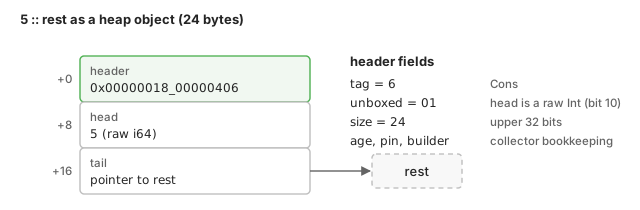
%30 = "eco.constant"() {kind = 2 : i32} : () -> !eco.value%31 = "arith.constant"() {value = 3 : i64} : () -> i64%32 = "eco.construct.list"(%31, %30) {head_kind = 1, head_unboxed = true} : (i64, !eco.value) -> !eco.valuehead_unboxed = true means the 3 is stored directly in the list cell. Under stock Elm's JavaScript, and under any compiler that does not know the element type, it would be a reference to a separately boxed number. sumTo, meanwhile, has become an scf.while loop that carries acc and n from one iteration to the next as i64 values and never calls itself.
More in MLIR generation and The eco dialect.
7. Lowering: from eco operations to memory
The backend, in C++, checks the module against the dialect's rules and then runs about twenty lowering passes, each rewriting eco operations into simpler ones until only LLVM's dialect is left. Take the list cell above. This is a test fixture from the compiler's suite, which builds a cell with an i64 head and checks that it lowers to the inline allocator:
func.func @value_to_heap_cons(%head: i64, %tail: !eco.value) -> !eco.value { %c = eco.make.cons %head, %tail : (i64, !eco.value) -> !eco.cons<i64, !eco.value> %h = eco.to_heap %c : (!eco.cons<i64, !eco.value>) -> !eco.value return %h : !eco.value}// CHECK: llvm.func @value_to_heap_cons// CHECK: llvm.call @__eco_alloc_inlineThe rewrite that main's eco.construct.list goes through does the same thing. From the lowering of eco.construct.list (trimmed):
uint64_t header = value_enc::composeHeader( value_enc::TagCons, headKind, layout::ConsSize);Value consHPtr = emitInlineAllocWithHeader( rewriter, loc, runtime, layout::ConsSize, header);emitFreshFieldStore(rewriter, loc, consHPtr, layout::ConsHeadOffset, headLLVM, op.getHead().getType());emitFreshFieldStore(rewriter, loc, consHPtr, layout::ConsTailOffset, tailVal, op.getTail().getType());rewriter.replaceOp(op, consHPtr);A cell is 24 bytes: a header word that says "Cons, with an Int head", the head, and a pointer to the tail. The header is a constant worked out at compile time, the head is the raw 64-bit integer, and nothing calls the runtime.
More in Lowering passes.
8. LLVM, linking and running
__eco_alloc_inline is not a real function. It is a marker that stays opaque through the MLIR passes and the translation to LLVM, and is expanded only once the code is in LLVM's form, before statepoint rewriting. From the comment that documents the expansion (trimmed):
%state = call ptr @eco_bump_state()
%top   = load ptr addrspace(1), ptr %state   ; bump.ptr at +0
%end   = load ptr addrspace(1), ptr %state+8 ; bump.end at +8 (clamped)
%new   = gep i8, %top, SIZE
%miss  = icmp ugt %new, %end
br %miss, slow, fast
slow:  %r = call ptr addrspace(1) @eco_alloc_inline_slow(SIZE)
fast:  store %new, %state
cont:  %obj = phi [ %top, fast ], [ %r, slow ]
Allocating is a pointer bump and one compare. The end of the allocation area is set in advance to the point where the next minor collection should start, so the same compare means both "the nursery is full" and "time to collect". Only the slow branch can run the garbage collector, and that branch is where LLVM's statepoint machinery records which values on the stack are heap pointers, so the collector can find and move them.
For an optimised build the module is split into partitions, LLVM optimises and compiles each one on its own thread, and the objects are linked with the prebuilt runtime and kernel libraries:
eco make src/Main.elm --output=mainThis produces a statically linked x86-64 executable of about 9 MB that needs nothing installed to run. Running it prints nothing, because main here is an Html value and there is no browser to show it in. Wrapping the string in Debug.log "main" before it reaches text shows that the native program computed what the JavaScript one would:
main: "7862,4,6"That is 78 from sumTo 0 12, 6 from area (Rect 2 3), and the doubled list joined with commas. A program meant for the terminal would use eco/system, which gives Elm files, processes, sockets and standard output.
More in The backend, The runtime and System libraries.
Further reading
- Eco at a glance — the ideas behind the stages on this page.
- Optimisations — every optimisation at every stage.
- Value representation — how values like the list cell above are laid out.
- Closures and calls — what happens to the calls that cannot be made direct.
- The full design document: The compiler theory
- Source:
compiler