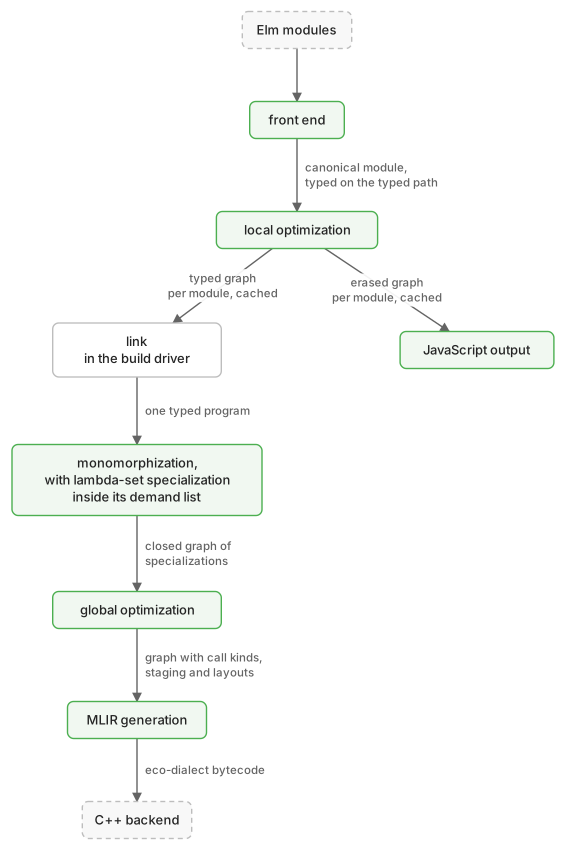
Eco's compiler works in two halves with a cache between them. The first half looks at one module at a time and keeps everything the type checker learned about it. The second half sees the whole program at once and uses those types to turn polymorphic, higher-order Elm into code where every value has one concrete layout and most calls go straight to a known function.
Background
- Monomorphization: making one copy of a polymorphic function for each concrete type it is used at.
- Lambda set: the set of functions that can reach a place that holds a function value.
- MLIR: a compiler framework for building intermediate languages; Eco's own is the eco dialect.
Two halves
The per-module half parses a module, resolves its names, type checks it, runs Elm's pattern checks and applies the optimisations that do not need concrete types. Its output is one typed graph per module, which the build caches on disk. It depends only on the module's source and the interfaces of the modules it imports, so an unchanged module is not compiled again.
The whole-program half links the cached graphs into one typed program rooted at main and runs a fixed list of steps over it. It specializes every function to the concrete types it is used at, works out which functions can reach each call, inlines, removes what nothing reaches any more, settles how each call is made, and writes the result as eco-dialect MLIR for the C++ backend.
Two properties of Elm make the whole-program half safe. Elm has no side effects, so inlining, deleting unreachable code or copying a function for one type changes nothing a program can observe. And the whole program is known, so the second half can start from main and see every use of every function. Languages with separate compilation and mutable state, such as C++ or OCaml, have to be more conservative on both counts.
Compute each fact once, where it can be computed
Each fact is computed once, at the step that can compute it, and passed forward as data. That rule shapes the whole compiler. The type of every expression is a fact about one module, so the front end records it. The concrete types a function is used at, the functions that can reach a call and how each call is made are facts about the whole program, so the second half decides them. Later steps read these decisions and never derive them again, so two steps cannot disagree about the same fact. The C++ passes follow the same rule one boundary further on: they read the compiler's decisions as attributes on the dialect's operations.
Typed or erased, chosen once per build
Stock Elm's optimiser throws types away, because JavaScript does not need them. Eco's native path does need them. Rather than change Elm's optimiser, Eco keeps a typed form of the optimised program beside Elm's erased one. MLIR and native outputs take the typed path. JavaScript and HTML take the erased path, Elm's own optimiser and generator, so Eco's JavaScript is what Elm produces.
Both paths share one constraint generator, which records each expression's solver variable only in typed mode. In our view one generator with a mode is the only safe arrangement: two near-identical generators drift, and ours once drifted far enough to report the same record-update error at different places in the source.
The parts
The typed path has six parts, in the order a program passes through them.
- The front end is Elm's own parser, name resolution, type checker and pattern checks, kept faithful to Elm's error messages. Its one addition is that it keeps the type of every expression.
- Local optimization rewrites each module before types are concrete: pattern matches become decision trees and self-recursion becomes loops.
- Monomorphization starts from
mainand makes one specialization of each function for each concrete type it is used at, typing each one with the type checker's own unifier. - Lambda-set specialization works out which functions can reach each call. It is not a separate pass: it runs inside monomorphization, in the same solver.
- Global optimization inlines, regroups curried functions by the arguments they take, and records how every call is made.
- MLIR generation writes the finished program out in the eco dialect. Everything has been decided by then, so it only reads decisions. Bytes fusion is a fast path inside it for
elm/bytesencoders and decoders.
Beside them sit JavaScript output, Elm's original generator, and the build driver, which runs everything over a project from the cache.
The build and the tests run the same steps
The whole-program half is a list of pure functions: number every variable, apply the pre-monomorphization rewrites, monomorphize, inline and prune, then globally optimise, with checkers between the steps. The build and the test suites call the same functions in the same order, because a harness with its own copy of the pipeline drifts and ends up checking output the real compiler never produces.
Compiler code must also run as JavaScript
The compiler is itself an Elm program, and before a native binary exists it runs under Node (see The compiler compiles itself), so the JavaScript engine's stack and heap limits apply to it. Recursion that grows with program size would overflow the stack on thousands of specializations, so graph algorithms use explicit work stacks and long chains such as let sequences are walked in tail-recursive loops that Elm compiles to plain loops.
On the compiler's own source, the native self-compile takes about a minute, several times faster than the compiler once managed, with roughly half the peak memory (Performance).
Further reading
- A tour through the compiler — one small program followed through every stage.
- The front end — where the types come from.
- Optimisations — every optimisation in one list.
- The full design document: The compiler theory
- Source:
compiler